


CCA Conductor Applied to Network Cable
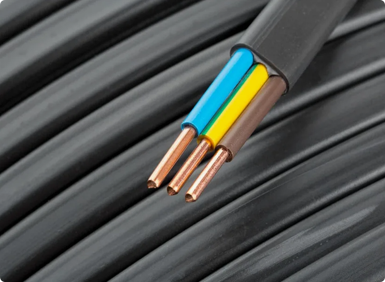
Copper or CCA? A More Economical Option
Copper has made it an unshakeable primary conductor since the birth of the first wire system in the 1800s by virtue of its good conductivity and low resistance. But this irreplaceability also puts an expensive price tag on copper. Network Lan cable (UTP Cables), as the representative of copper cable, still occupies the mainstream.
In order to avoid the high cost brought by copper, the application of CCA seems become the best solution. Thanks to the skin effect and proximity effect generated by high-frequency current, the CCA with higher DC resistance can even achieve the same conductivity as the copper during operation. According to the calculation, the skin depth is 0.00922mm at 50MHz. From this frequency onwards there will no obviously difference in the attenuation between the CCA and copper. This is why Lan cables with CCA conductors are sufficient to pass the Fluke 90M Channel test (While Network Analyzer and Permanent Link fail). However, mechanically, compared with copper conductors, CCA has worse tensile strength and elongation, and worse flexibility.
Nowadays, for the Lan cables with the highest usage in households, especially Cat5E and Cat6, under the drive of market price competition, the Lan cables with CCA as the conductor are favored by end customers due to their economy, gradually occupy more market share.
Both are Called CCA? Copper “Clad” Aluminum VS. Copper “Covered” Aluminum
The CCA mentioned above actually refers to Copper Clad Aluminum, which is made by bonding a layer of pure copper onto an aluminum core using cladding welding technology. And there is a clear standard in the industry, namely ASTM B566. Unfortunately, many cable manufacturers try and cut corners by using as little copper as possible. Another CCA, that is Copper “Covered” Aluminum or much precisely Copper “Plated” Aluminum is also popularizing in the market. It uses electroplating solution to plate a layer of copper on the zinc-filmed aluminum core. Although this kind of CCA(CPA) is cheaper, the copper layer is much thinner, the electrical performance is also poor, and the copper layer is easy to peel off, causing it is very vulnerable to oxidation and corrosion. The following table listed a detailed comparison of the two CCAs in Nominal values
Sanyuan Commitment
Sanyuan always treats each of clients with respect, transparency and loyalty. For all CCA conductor Cat5E and Cat6 Lan cables with large quantities and single specifications, we promise you to stick to the Copper “Clad” Aluminum conductor instead of using lower-grade Copper “Covered” Aluminum at the expense of quality and efficiency. In a competitive and rapidly changing market, we help our valued clients strike a balance between performance and cost, giving you guaranteed performance without having to pay outrageous repair or replacement prices.
Reference:
ASTM B566-04a(2021): Standard Specification for Copper-Clad Aluminum Wir
We are here for you
 Contact with us







ZEN KABEL
GUIFANGQIAO INDUSTRIAL ZONE, LIN'AN DISTRICT, HANGZHOU CITY, ZHEJIANG PROVINCE, CHINA. 311312
© 2026 HANGZHOU ZENKABEL TECHNOLOGY CO., LTD | Powered by HANGZHOU